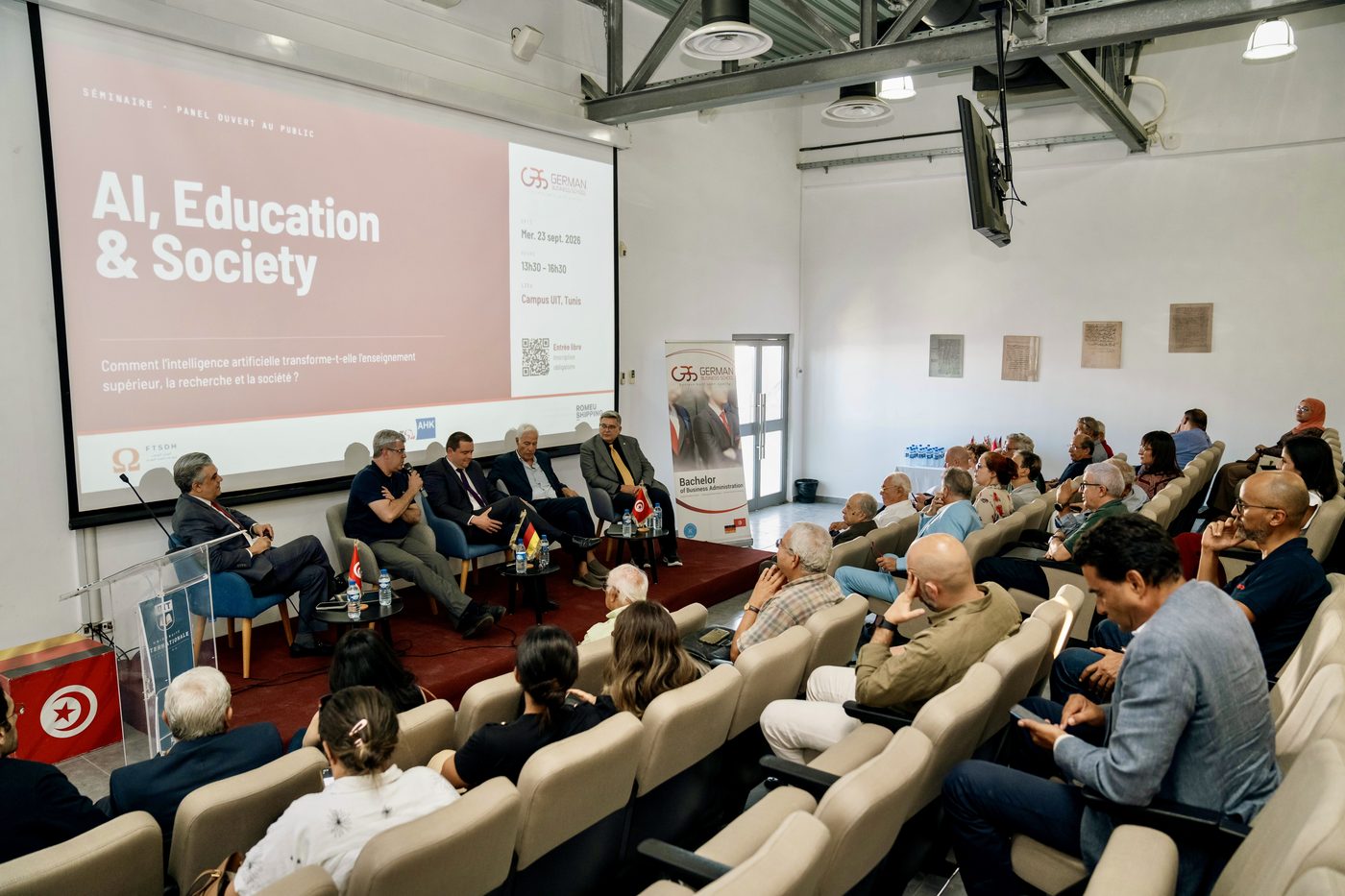
23 September 2026 | UIT Campus, Tunis
On 23 September 2026, at the UIT Campus in Tunis, the German Business School (GBS) brought together German and Tunisian academics for the panel discussion "AI, Education and Society". Organised in partnership with AHK Tunisia and the German Embassy, the debate was part of the celebrations marking 70 years of Tunisian-German relations and 10 years of GBS in Tunisia.
Opening the session, Mr. Maher Tebourbi, Founding President of GBS and head of international cooperation at UIT, looked back on the past ten years. He described a genuine Tunisian-German ecosystem, and more broadly a Euro-African one, built together with AHK, the German Embassy, DAAD and other German organisations.
He also presented the series of seminars and debates on artificial intelligence launched last year with the Tunisian Forum for Knowledge and Human Development (FTSDH). Finally, he highlighted the integration of AI modules across all UIT programmes, including law.
Putting technology at the service of people
Prof. Ahmed Friaâ, President of the FTSDH and former minister, opened the talks by quoting a letter from Voltaire to d'Alembert: science is valuable when it produces useful truths, not merely difficulties overcome. For a nation, the technological transition only makes sense if it improves the future of its people.
"What matters most is how to put technology at the service of people."
Prof. Ahmed Friaâ, President of the FTSDH
What sets AI apart from earlier revolutions, he stressed, is autonomy. The relationship between humans and machines used to be vertical, that of a master and an apprentice. Today, the machine is no longer a mere executor: it takes initiative and reproduces large parts of human cognitive abilities. The quantum revolution also raises a question of data sovereignty, since it will eventually be able to break today's encryption systems.
For Tunisia, he drew several conclusions:
- moving from the teacher as holder of knowledge to the teacher as facilitator;
- distinguishing those who will develop AI systems, who need solid mathematical foundations, from the large majority who will need to use them well;
- encouraging boldness and creativity;
- taking the country's socio-cultural specificities into account.
One example illustrates this last point: in the 1990s, mobile phone use differed radically between Scandinavian and Mediterranean countries.
Knowledge remains the foundation, judgement makes the difference
Prof. Dr. Robert U. Franz, from the Technische Hochschule Brandenburg, presented "The German Higher Education Model in the Age of AI". His starting point: AI changes the value of knowledge, not the need for it.
Until now, education valued the ability to memorise and reproduce an answer. It must now teach students to judge it, apply it and defend it. The question is no longer "Can you produce the answer?" but "Can you understand and own it?".
He illustrated the profile of the AI-ready graduate as a four-level pyramid:
- at the base, disciplinary knowledge;
- then solving real problems;
- then critical judgement: verifying, challenging, contextualising;
- and only at the top, AI literacy.
All of this serves human agency.
"The goal is not better prompting. It is better professional judgement."
Prof. Dr. Robert U. Franz, TH Brandenburg
On assessment, his principle is simple: if AI can do the assignment, redesign the assignment. He proposes moving exams towards increasingly authentic tasks. Starting from simple recall, through solving cases and justifying choices, all the way to working in a real system.
He recalled the precedent of calculators, which some wanted to ban in the 1970s. Banning AI would make no more sense. In his SAP courses, he no longer asks students to repeat transaction steps. They must solve a complete business problem, from order to invoice, and then explain their decisions.
For Tunisian-German cooperation, his motto is to co-create, not copy. The future lies not in exporting one model, but in joint experimentation. Each country brings its own strengths:
- Germany, its applied sciences, its industry links and its dual, practice-based learning;
- Tunisia, its talent, its ambition, its regional perspective and its digital potential.
Four areas of work open up: AI-supported teaching, authentic assessment, joint research and two-way mobility. All of them address a shared question: what should students learn when AI is always available?
Making juniors senior: the GBS response
Dr. Sami Bahri, AI expert and Program Manager at GBS, broadened the perspective based on his experience in business consulting. We live in an attention society, where an abundance of information creates a poverty of attention. Technology evolves exponentially, while our capacity to adapt remains linear.
He then described the "Gen Z dilemma". Entry-level positions, where young people used to learn the job over two or three years, are disappearing in favour of AI. Following Schumpeter's logic of creative destruction, the jobs destroyed do not reappear in the same place or at the same time.
"Since juniors can no longer find entry-level jobs, the answer is to make them senior, starting at university. And that is exactly what we do at GBS."
Dr. Sami Bahri, GBS
Hence the need to "make juniors senior": to pass on at university the judgement that companies used to teach. The idea draws on the "centaur" concept developed by Garry Kasparov, in which humans equipped with the right technology outperform the machine alone. This is the approach of the Mini-MBA "AI Enablement for Project Managers", whose first cohort has just completed its programme at GBS.
Dr. Bahri also emphasised the principle of "my data, my AI": companies will need to learn to train their own models to protect their intellectual property. He concluded on a political responsibility: neither universities nor companies can manage this transition on their own.
Capable with AI, not helpless without it
Prof. Dr. Markus Breuer (SRH) devoted his talk to "AI in Higher Education: Skills, Judgement and Employability". He opened with an anecdote: a colleague refuses to include AI in his module descriptions, just as he does not include the calculator.
The figures prove him right; AI has become a basic tool:
- 78% of surveyed organisations were already using AI in 2024 (Stanford AI Index 2025);
- half of employers plan to re-orient their business in response;
- two thirds plan to hire talent with specific AI skills (World Economic Forum, Future of Jobs Report 2025).
The labour market has already moved.
"AI dramatically lowers the price of an answer. That raises the value of a good question, and even more, a justified judgement."
Prof. Dr. Markus Breuer, SRH
He illustrated this with a thesis in which a student had applied a SWOT analysis unrelated to the research question. To avoid this pitfall, he set out four steps: frame the problem, choose the method, check the evidence, make a judgement.
AI does not make domain knowledge obsolete; it makes shallow knowledge more dangerous. He proposes a three-stage progression: understand, apply, and only then automate. His own experience bears this out. A data collection he expected to finish in two hours with AI took him a day and a half, the time needed to find the right prompts and verify everything.
He advocates learning in two modes:
- "AI off", to demonstrate foundations, independent reasoning and critical reading;
- "AI on", to demonstrate tool selection, verification and responsible use.
The aim is to assess both the independent mind and the augmented professional. The ultimate goal is to educate people who can do more, and better, with AI, without being helpless without it.
A lively debate with the audience
The discussion with the audience covered several topics:
- the responsibility for a human decision based on an AI that does not explain its reasoning;
- education from primary school onwards, in light of the PISA results;
- work-study programmes as a lever for making juniors senior;
- the risk of AI deepening inequalities;
- data governance in companies.
Prof. Friaâ warned against the idea that a path without mathematics is a failure. In his view, young people's disaffection with maths also stems from the way it is taught. H.E. Habib Ben Yahia, former Minister of Foreign Affairs, closed the discussion by recalling the international openness of Tunisian education since independence.
Upcoming events
UIT and the FTSDH are preparing the Carthage Colloquium for 2027. It aims to produce "Carthage Recommendations" on the environment, technology and geopolitics. The next step in the series, "AI and Industry", will take place on Saturday, 24 October 2026.
GBS thanks the FTSDH, AHK Tunisia and Transglory Tunisia (Grupo Romeu) for their support.
German Business School | Success upon quality